
Mooresville Sources for Previous Residents
One address can have several timelines. Recorded land identifies parties to a transfer. A city directory can place a named household or telephone subscriber at an address in a printed year. Census and local-history resources add family and community context. Maps show the building and street setting rather than its occupants. Use each source for the point it actually supports, and do not turn an owner field into proof that every person at the address lived there.
| Source | Years it covers | Where held | What it shows |
|---|---|---|---|
| Iredell land records | December 1788 to present | Register of Deeds | Named parties, instruments, recording references, and legal land trail |
| Mooresville directories | Verified 1939-1940 through 1963-1964, plus a 1968 listing | DigitalNC and library collections | Dated names, addresses, telephone, street, and classified entries |
| Sanborn maps | 1902, 1908, 1914, and 1925 | Library guide resources | Structures, use, and street context |
| Obituary index | 1933-2019 | Iredell library indexes | Historical death-notice lead with spelling caveats |
| HeritageQuest census | 1790-1940 | Library-provided route | Household context and historical schedules |
The combination is what makes a past-residents search useful. It is not a single database, and gaps should remain visible rather than filled with assumptions.
Mooresville Addresses Start With the Current Parcel
Begin with the Iredell assessor or MapGeo record for the current street address. Capture the PIN, account number, current owner field, deed date, book and page if shown, legal description, and plat references. The PIN is the reliable bridge across county systems. A street address can change, be renumbered, or be expressed differently in a historical directory. Do not use the street text alone as the join key.
County Addressing assigns a number from the driveway access point, not necessarily the structure. It also uses road-name rules, odd and even sides, and standardized suffixes. A 1994 Mooresville Tribune scan records changes including Red Oaks to Whispering Oaks Court. Preserve an earlier spelling when searching an old directory, then test it against current mapping instead of silently replacing it.
Mooresville Deed Chains Run Backward by Name
Iredell deeds are not indexed by street or address. The practical backward trail begins with the current deed reference or owner name, then works through grantee and grantor entries. A grantee receives the interest shown in an instrument. A grantor transfers it. Search each party name with date limits when possible, open available record images, and record the prior reference named in the instrument. Ownership transfers can form a chain of title, while an occupancy question needs directory and census evidence as well.
- Search the current address in the assessor record and save the PIN and deed reference.
- Open the Register of Deeds route and search the current owner as grantee or grantor.
- Read the deed image for all parties, date, legal description, book or page, and prior references.
- Use the earlier named party as the next search key and repeat by date.
- Compare the resulting years with directories, maps, and newspapers for household context.
- Grantor
- The party transferring an interest in a recorded instrument.
- Grantee
- The party receiving that interest.
- Chain of title
- The sequence of recorded transfers used to trace a parcel's ownership history.
- Legal description
- The recorded land description; it is stronger than a street address for parcel identity.
Iredell's official land-record page provides the current entry point and office information.
Mooresville Deed Searches Have a 2026 Split
Land-record coverage reaches from December 1788 to the present, but the online route requires extra care in 2026. Iredell's MapGeo datasets notice says the Register of Deeds began moving from Cott Systems to Courthouse Computer Systems on June 2, 2026. Cott was expected to close on June 1. Instruments after that date can be missing from the old search while the new system is prepared.
Use the official county landing page, not a saved vendor shortcut, to see the current instructions. If the county directs a searcher to both systems, record which one supplied each result. A gap in one vendor result does not establish that a transfer did not occur. The Register of Deeds office can help when an old book and page, name ambiguity, or vendor transition makes an index result uncertain.
Note: Online deed access is countywide, while the office location and vendor screen can change without changing the underlying recorded instrument.
Iredell's fee material distinguishes a search result from a copy request. The published schedule lists a $38 response to a written request and $38 for an electronic request where permitted, while copy and certification charges vary by format. Confirm the live schedule before sending payment. The Register of Deeds cannot prepare legal documents under North Carolina General Statutes §§84-4 and 84-5, so a deed search should stop at locating and obtaining the recorded material rather than asking the office to interpret or draft a transfer.
Mooresville Directories Show Past Households
Digitized city directories give the household layer that deeds cannot provide. Verified Mooresville issues include Miller's 1939-1940 numerical telephone directory; 1950-1951 alphabetical, street, and classified material; 1954-1955; 1959-1960; 1961-1962; and 1963-1964. The library also lists a 1968 city directory, though a direct digitized official item was not located. A run can establish a dated address or telephone relationship, not present residence.
DigitalNC's 1961-1962 Mooresville directory record preserves alphabetical, street, and classified content from that edition.
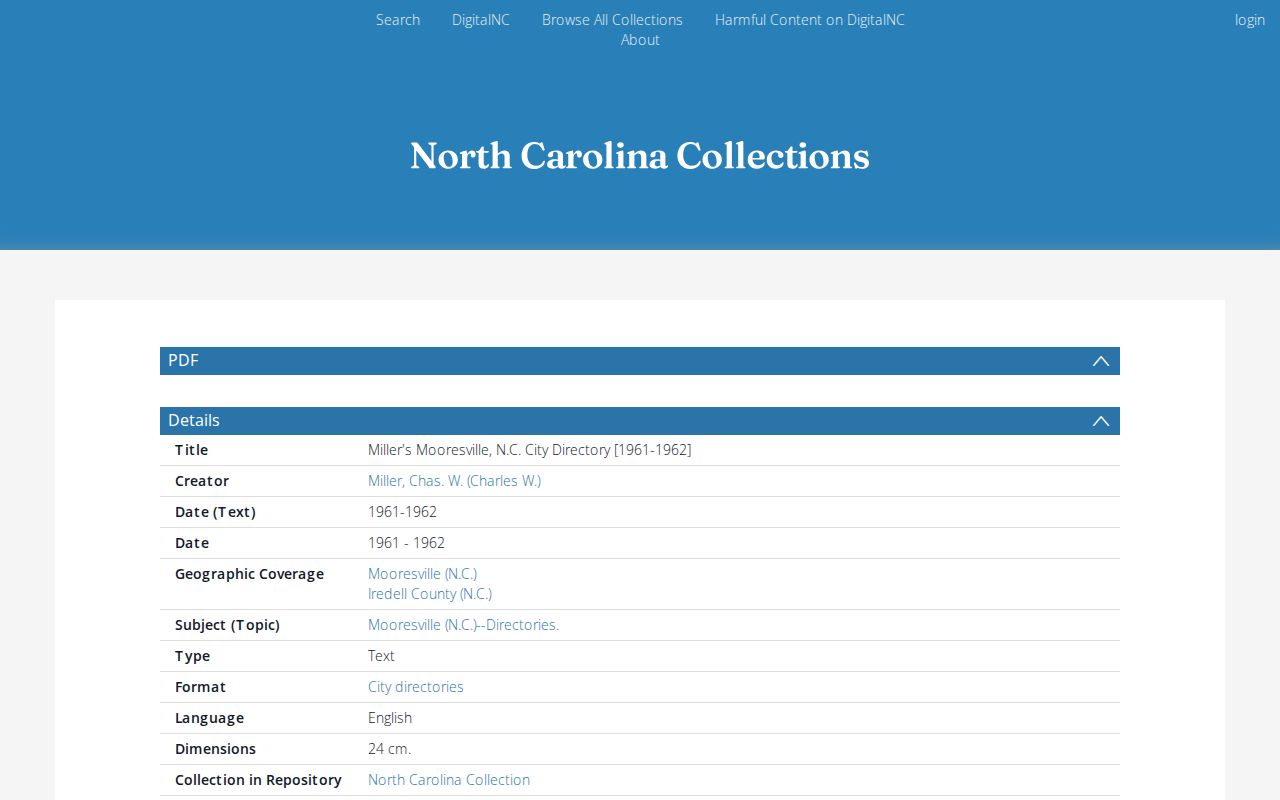
Directory abbreviations are part of the evidence. In the 1961-1962 book, h means house or home, r means resides or residence, and wid means widow. Transcribe them with the year and do not translate them into a modern identity claim.
The Mooresville city directory collections page explains the volumes and entry fields in depth, while this record trail uses them to test one address over time.
Pair the directory years with the federal census years available through library resources, while remembering that the two sources were compiled for different purposes. A directory can place a household at a short dated stop between censuses. A census can broaden the household picture. A missing listing may signal a move, a changed subscriber name, a publisher omission, or a gap in the surviving run. It does not by itself prove a death, relationship, or permanent departure.
Mooresville Archives Add Maps and Notices
Mooresville Public Library's Local History & Archives repository includes maps, photographs, films, manuscripts, census indexes, genealogy resources, yearbooks, church material, family collections, and historical newspapers. The guide lists Mooresville Sanborn map editions for 1902, 1908, 1914, and 1925. A Sanborn sheet can show building footprints, use, and historic street context. It is not an occupancy list, so pair it with a directory, deed, or dated notice.
Mooresville Local History & Archives is the repository route for digitized local material.
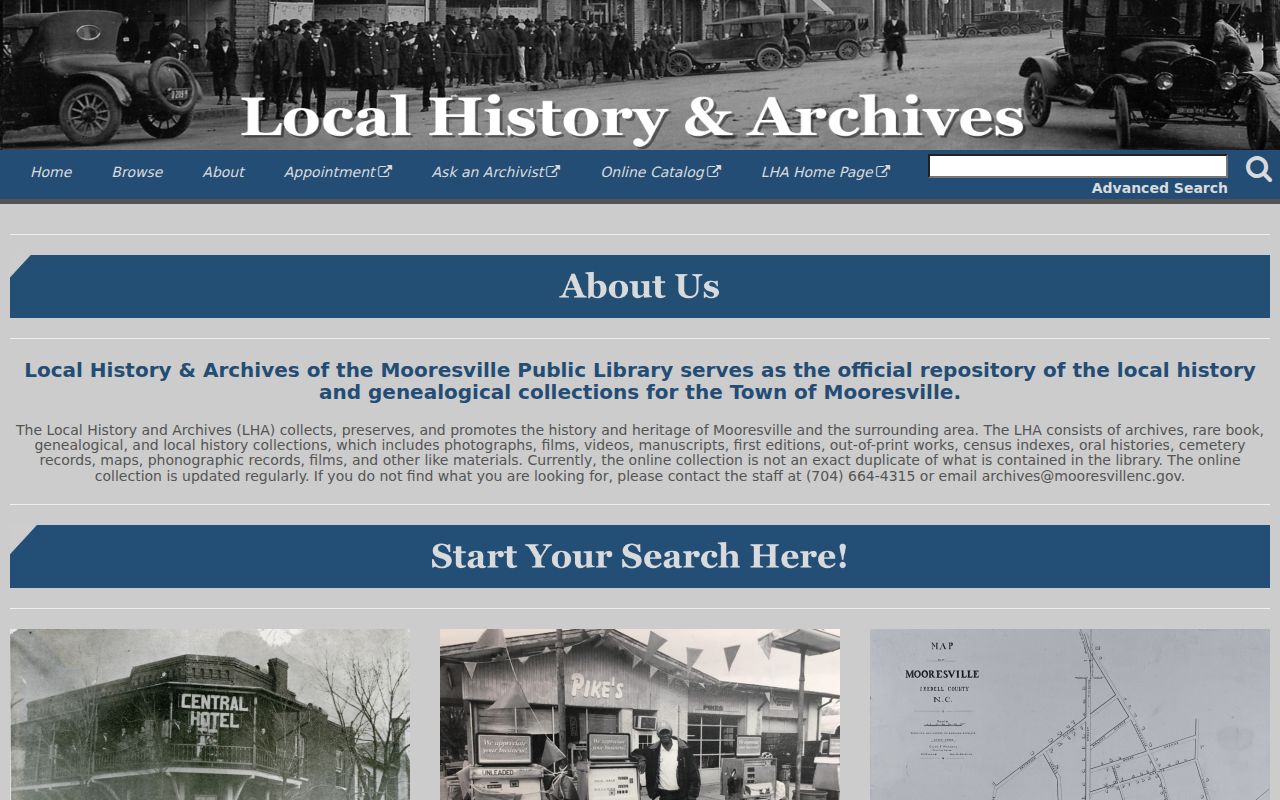
The online collection is not a full mirror of the physical holdings. The library's free request service can search the collection when given name variants, approximate dates, a street, relatives, and the record type being sought.
Use the Iredell County obituary index, which covers 1933-2019, and historic Record and Landmark newspaper material as dated leads. Check spelling and source dates. A notice may identify a family connection or event without establishing that a named person lived at a particular house.
The library guide also identifies marriage-register abstracts for 1854-1964, birth-announcement indexing for 1954-1971, veteran burial locations, subject and family files, and historic newspapers. Those collections can explain a name change, an estate connection, or a family move when the deed chain alone is thin. They are complementary sources. None should be used to treat a past record as a present contact record.
Mooresville Past Records Include a Courthouse Gap
Iredell County was formed from Rowan County in 1788, so a pre-1788 lead may belong in Rowan-related or grant-series material rather than an Iredell-only index. The December 18, 1854 Statesville fire destroyed nearly half of the town, including the courthouse. Private marriage records survived. That history explains why a courthouse series can have a gap while a marriage abstract, family Bible, or library source still offers evidence.
For older material, the State Archives holds county-record categories such as bonds, court, land, estate, marriage, tax, and wills. The Iredell archival inventory is a dated finding aid, so confirm present custody before making a trip or promising that a file survives. The Genealogical Society's Heritage Room adds mostly nondigitized family Bibles, private collections, and local-history material by appointment.
That historical context is also a reason to describe uncertainty plainly. An absent courthouse entry can reflect a fire loss, a different county of origin, an index gap, or a record series that has not been digitized. It cannot establish that the event never happened. Pair the State Archives route with the library's research request, marriage-register abstracts, and the Register of Deeds where those sources fit the date and event.
Mooresville Previous Residents Require Care
House history, family history, and personal curiosity are legitimate reasons to work through dated public records. The boundary is important. A past address, obituary, or directory entry is not permission to track or contact a living person. Address Confidentiality Program participants have protected substitute addresses, and court, voter, vital, and other records have statutory limits. Do not attempt to reconstruct an address that a custodian has withheld.
Use the minimum information needed to answer the historical question. Preserve record dates, source citations, and uncertainty. North Carolina's stalking and cyberstalking statutes prohibit harmful conduct. When a result is protected, incomplete, or contradictory, leave the gap and ask the stated custodian about lawful access rather than trying to work around it.